Quality Assurance – “Good Enough” is not in our vocabulary

Quality Assurance – “Good Enough” is not in our vocabulary

“Good Enough” is not in our vocabulary.

Ensuring high-quality output isn’t just a step in our workflow—it’s woven into everything we do. Our quality assurance process spans multiple departments, each playing a critical role in delivering consistent, flawless results for our clients.


The Cascade Print Media Quality Assurance Process: Ensuring Excellence in Every Print

At Cascade Print Media, quality isn’t an afterthought—it’s the foundation of everything we do. Whether it’s a high-end brochure, a trade show display, or a simple business card, we take every step necessary to ensure that the final product exceeds expectations. Here’s a behind-the-scenes look at how we maintain precision, consistency, and excellence at every stage of production.


  1. Project Consultation

While it may sound silly, quality starts before the art, job and paper are even ordered.

  • How will the product be used
  • What is the end goal
  • What materials are needed to ensure durability, appearance and brand consistency

Why It Matters: This ensures we order the correct materials that will ensure durability, appearance and brand consistency. Having the right material sets everyone up for success.

  1. Pre-Press: Where Quality Begins

Before ink ever touches paper, we set the stage for success with a meticulous pre-press quality control process.

  • File Verification: We check resolution, bleeds, margins, and color settings to ensure every file is production-ready
  • Proofing: Digital and physical proofs allow clients to review and approve designs before production
  • Material Verification: We confirm the best materials for durability, appearance, and brand consistency
  • Preflight Inspection: We catch common issues—like missing fonts or low-res images—before they become costly mistakes
  • Color Accuracy: Whether matching Pantone colors or ensuring brand consistency, we fine-tune colors to be spot-on.

Why It Matters: A single overlooked error in pre-press can lead to reprints, delays, and unnecessary costs. We take the time to get it right before printing begins.

  1. Production: Precision in Every Print

Once we move to production, our teams monitor every detail to maintain consistency and clarity.

  • Print & Color Matching: We continuously check colors against brand guidelines to ensure every piece is accurate
  • Sample Inspections: We pull samples during production to verify sharpness, ink coverage, and alignment and print quality
  • Real-Time Adjustments: Operators fine-tune ink levels, registration and settings to maintain a flawless finish
  • Uniformity Checks: We inspect for color shifts or imperfections across large print runs
  • Quality Checks for Apparel & Promo: From checking stitching to ensuring imprint placement, we inspect each item closely
  • Third Party Inspection: We have a third set of eyes, not involved in the project, inspect each job before giving it the final approval to move to finishing

Why It Matters: Quality isn’t just about the first item—it’s about ensuring every single piece in the order meets the highest standards.

  1. Finishing & Bindery: Details Make the Difference

After production, our finishing team ensures that every project is assembled, finished and packed with precision.

  • Trim & Die-Cut Precision: Clean cuts, sharp edges, and exact measurements are a must
  • Binding & Folding Checks: Whether it’s a booklet, brochure, or apparel tag, we ensure alignment is perfect
  • Lamination & Coating: We apply finishes that enhance durability and appearance—free from bubbles or imperfections
  • Apparel and Product Inspection: We check for thread consistency, proper placement, and flawless application
  • Spot-Check Sampling: Before packaging, we inspect samples to confirm final quality

Why It Matters: The final presentation of a product is just as important as the product itself. Even the slightest misalignment can impact a brand’s reputation.

  1. Packaging & Shipping: Delivering Perfection

The last step in our process ensures that your materials arrive in pristine condition.

  • Final Inspection: We verify quantities, quality, and specifications before packaging
  • Protective Packaging: From shrink-wrapping to reinforced boxes, we package with care
  • Label Accuracy: Every order is checked for correct addresses and special shipping requests
  • Reliable Delivery: We work with trusted carriers to ensure on-time, damage-free delivery

Why It Matters: A flawless order is useless if it arrives damaged. Our final checks guarantee your materials look just as good when they arrive as when they left our shop.


Why Our Quality Control Process Sets Us Apart

Quality isn’t just a department—it’s a mindset across every stage of production. Whether it’s a business card or a large-scale wall graphic, we follow the same rigorous process to ensure your brand looks its best, every time. From pre-press to packaging, every team member plays a role in ensuring the final product is something we’d be proud to put our name on.


Looking for a print partner that takes quality seriously? Let’s chat! Whether it’s business cards or large-format signage, we’re here to ensure every product makes an impact.

📢 Want to see our QA process in action? Schedule a tour—we love showing off what we do!

 

Digital vs. Offset Printing: What is the Difference?

Digital vs. Offset Printing: What is the Difference?

​

When it comes to printing, choosing the right method can make all the difference in quality, cost, and turnaround time. Two of the most common techniques—digital printing and offset printing—each have unique advantages and are suited to different types of projects. Here’s a breakdown to help you understand the key differences and decide which is best for your needs.

What Is Digital Printing?

Digital printing is a modern method where images are printed directly from a digital file to the substrate (paper, cardstock, etc.), similar to how a home or office printer works. It’s ideal for smaller runs and projects that require quick turnaround.

Advantages of Digital Printing:

  • Speed: Because there’s no need for setup like creating printing plates, digital printing is faster, making it perfect for tight deadlines.
  • Cost-Effective for Small Runs: Without setup costs, digital printing is more economical for small quantities.
  • Variable Data Printing: Digital printing allows for customization, such as personalizing each printed piece with unique names, addresses, or images.
  • On-Demand Printing: Projects can be printed in smaller batches, reducing waste and inventory costs.

What Is Offset Printing?

Offset printing is a traditional method that uses printing plates to transfer ink onto a rubber blanket and then onto the paper. It’s ideal for large runs and projects that demand the highest quality.

Advantages of Offset Printing:

  • Superior Quality: Offset printing delivers crisp, vibrant, and precise results, particularly for detailed designs and large areas of solid color.
  • Cost-Effective for Large Runs: While setup costs are higher, the per-unit cost decreases significantly with volume, making it a more economical option for large quantities.
  • Wide Range of Materials: Offset printing can handle a broader range of paper types, weights, and finishes, offering more creative options.
  • Color Accuracy: The use of Pantone colors and precise ink control ensures consistent, high-quality results.

Comparing Digital and Offset Printing

Feature Digital Printing Offset Printing
Setup Time Minimal Longer
Cost for Small Runs More affordable Higher due to setup costs
Cost for Large Runs More expensive per unit More cost-effective per unit
Turnaround Time Faster Slower due to setup and drying times
Customization Ideal for variable data and personalization Limited to fixed designs
Material Options Limited Wide variety
Print Quality Excellent for most needs, but less precise in details Exceptional, especially for complex designs


When to Choose Each Method

  • Digital Printing:
    • Short runs (usually under 500 copies)
    • Personalized or variable data projects
    • Tight deadlines
  • Offset Printing:
    • Large quantities (usually around 1,000+ copies)
    • Projects requiring Pantone color matching
    • High-end marketing materials, like brochures and catalogs


The Best of Both Worlds

Some projects might even combine both methods to maximize benefits. For example, offset printing could be used for the main run of a project, with digital printing handling customized components.

Whether you’re printing business cards, flyers, or a large-scale catalog, understanding the difference between digital and offset printing ensures your project gets the attention it deserves.

Have a printing project in mind? Contact us today to determine which method is right for you!


CMYK vs RGB vs PMS – What Is The Difference?

CMYK vs RGB vs PMS – What Is The Difference?

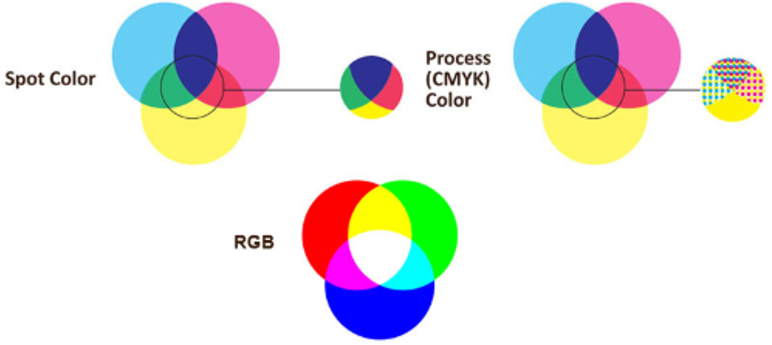
RGB : Red Green Blue

RGB stands for Red, Green, Blue. These three colors are essentially additive light colors that are used to make new colors. When all three are combined, it creates white. When no light colors are added, it shines black. The stronger the light intensity, the brighter and more vibrant the color appears. RGB colors are considered additive colors and added to a black screen.

When to use: RGB is often used by graphic designers and others who use computers to design art. RGB can only be used on screens and other technological devices. Due to some technology limitations, our computer screens, TV screens and other device screens can’t display every color our eyes are able to see. RGB offers more colors, that are more vibrant than CMYK.


CMYK: Cyan, Magenta, Yellow, Black

CMYK stands for Cyan, Magenta, Yellow and blacK,  and often referred to as 4-color process. It offers a larger scope of colors than RGB. Additionally, CMYK colors are considered subtractive colors and added to a white “screen”, or paper, to block out the light reflecting off paper. When adding cyan, magenta and yellow together, you would not get black unless adding them multiple times, causing more expense. Adding in a true black is time efficient and budget friendly. The CMYK color range allows for colors to be displayed more accurately and colors are presented in small, tiny, indiscernible dots to create the most accurate color possible.

When to use: CMYK is used on print materials such as paper, banners, apparel, promotional products and vehicle graphics. CMYK is best for photographs and designs that incorporate multiple colors or gradients


PMS: Pantone Matching System

PMS stands for Pantone Matching System and uses solid colors, sometimes known as spot colors. PMS colors are not recommended for color blending, as using multiple PMS colors can get expensive. Each Pantone color is solid and assigned a unique number to ensure consistency across print mediums. While you can convert PMS colors to CMYK colors, results often vary.

When to use: PMS is best used on logos and other branding, and best for projects with 1 to 3 solids colors without photographs or blending. It can be used to achieve colors outside the CMYK range of colors.


Color Process

When Best Used

Usage

Conversion

CMYK

Print Materials - especially with lots of colors Print Materials – good for blending, 2 or more colors, does not have to be solid artwork Can convert to RGB

RGB

Digital Designs Digital Screens Can convert to CMYK

PMS

Logos and Branding & Solid Colored Artwork Print Materials – no blending, 1-3 colors max, must be solid artwork Can convert to CMYK/RGB, but differences often occur

Resources: differencebetween.net, printernaational.org,

Cascade Print Media offers a wide range of options for both PMS and CMYK printing. We offer press checks upon request, so you can see your project being printed in real time, check the colors to ensure they match your branding standards, and get a tour of our facility!

Still not sure which option is best for you? Don't worry -- one of our printing experts would be happy to sit down with you to find the best options to meet your budget and ensure your project comes out exactly how you want it.