CMYK vs RGB vs PMS – What Is The Difference?
RGB : Red Green Blue
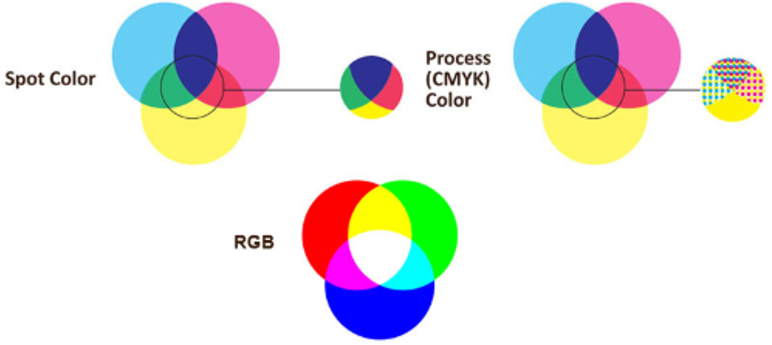
RGB stands for Red, Green, Blue. These three colors are essentially additive light colors that are used to make new colors. When all three are combined, it creates white. When no light colors are added, it shines black. The stronger the light intensity, the brighter and more vibrant the color appears. RGB colors are considered additive colors and added to a black screen.
When to use: RGB is often used by graphic designers and others who use computers to design art. RGB can only be used on screens and other technological devices. Due to some technology limitations, our computer screens, TV screens and other device screens can’t display every color our eyes are able to see. RGB offers more colors, that are more vibrant than CMYK.
CMYK: Cyan, Magenta, Yellow, Black
CMYK stands for Cyan, Magenta, Yellow and blacK, and often referred to as 4-color process. It offers a larger scope of colors than RGB. Additionally, CMYK colors are considered subtractive colors and added to a white “screen”, or paper, to block out the light reflecting off paper. When adding cyan, magenta and yellow together, you would not get black unless adding them multiple times, causing more expense. Adding in a true black is time efficient and budget friendly. The CMYK color range allows for colors to be displayed more accurately and colors are presented in small, tiny, indiscernible dots to create the most accurate color possible.
When to use: CMYK is used on print materials such as paper, banners, apparel, promotional products and vehicle graphics. CMYK is best for photographs and designs that incorporate multiple colors or gradients
PMS: Pantone Matching System
PMS stands for Pantone Matching System and uses solid colors, sometimes known as spot colors. PMS colors are not recommended for color blending, as using multiple PMS colors can get expensive. Each Pantone color is solid and assigned a unique number to ensure consistency across print mediums. While you can convert PMS colors to CMYK colors, results often vary.
When to use: PMS is best used on logos and other branding, and best for projects with 1 to 3 solids colors without photographs or blending. It can be used to achieve colors outside the CMYK range of colors.
Color Process |
When Best Used |
Usage |
Conversion |
CMYK |
Print Materials - especially with lots of colors | Print Materials – good for blending, 2 or more colors, does not have to be solid artwork | Can convert to RGB |
RGB |
Digital Designs | Digital Screens | Can convert to CMYK |
PMS |
Logos and Branding & Solid Colored Artwork | Print Materials – no blending, 1-3 colors max, must be solid artwork | Can convert to CMYK/RGB, but differences often occur |
Resources: differencebetween.net, printernaational.org,
Cascade Print Media offers a wide range of options for both PMS and CMYK printing. We offer press checks upon request, so you can see your project being printed in real time, check the colors to ensure they match your branding standards, and get a tour of our facility!
Still not sure which option is best for you? Don't worry -- one of our printing experts would be happy to sit down with you to find the best options to meet your budget and ensure your project comes out exactly how you want it.