Digital vs. Offset Printing: What is the Difference?

Digital vs. Offset Printing: What is the Difference?

​

When it comes to printing, choosing the right method can make all the difference in quality, cost, and turnaround time. Two of the most common techniques—digital printing and offset printing—each have unique advantages and are suited to different types of projects. Here’s a breakdown to help you understand the key differences and decide which is best for your needs.

What Is Digital Printing?

Digital printing is a modern method where images are printed directly from a digital file to the substrate (paper, cardstock, etc.), similar to how a home or office printer works. It’s ideal for smaller runs and projects that require quick turnaround.

Advantages of Digital Printing:

  • Speed: Because there’s no need for setup like creating printing plates, digital printing is faster, making it perfect for tight deadlines.
  • Cost-Effective for Small Runs: Without setup costs, digital printing is more economical for small quantities.
  • Variable Data Printing: Digital printing allows for customization, such as personalizing each printed piece with unique names, addresses, or images.
  • On-Demand Printing: Projects can be printed in smaller batches, reducing waste and inventory costs.

What Is Offset Printing?

Offset printing is a traditional method that uses printing plates to transfer ink onto a rubber blanket and then onto the paper. It’s ideal for large runs and projects that demand the highest quality.

Advantages of Offset Printing:

  • Superior Quality: Offset printing delivers crisp, vibrant, and precise results, particularly for detailed designs and large areas of solid color.
  • Cost-Effective for Large Runs: While setup costs are higher, the per-unit cost decreases significantly with volume, making it a more economical option for large quantities.
  • Wide Range of Materials: Offset printing can handle a broader range of paper types, weights, and finishes, offering more creative options.
  • Color Accuracy: The use of Pantone colors and precise ink control ensures consistent, high-quality results.

Comparing Digital and Offset Printing

Feature Digital Printing Offset Printing
Setup Time Minimal Longer
Cost for Small Runs More affordable Higher due to setup costs
Cost for Large Runs More expensive per unit More cost-effective per unit
Turnaround Time Faster Slower due to setup and drying times
Customization Ideal for variable data and personalization Limited to fixed designs
Material Options Limited Wide variety
Print Quality Excellent for most needs, but less precise in details Exceptional, especially for complex designs


When to Choose Each Method

  • Digital Printing:
    • Short runs (usually under 500 copies)
    • Personalized or variable data projects
    • Tight deadlines
  • Offset Printing:
    • Large quantities (usually around 1,000+ copies)
    • Projects requiring Pantone color matching
    • High-end marketing materials, like brochures and catalogs


The Best of Both Worlds

Some projects might even combine both methods to maximize benefits. For example, offset printing could be used for the main run of a project, with digital printing handling customized components.

Whether you’re printing business cards, flyers, or a large-scale catalog, understanding the difference between digital and offset printing ensures your project gets the attention it deserves.

Have a printing project in mind? Contact us today to determine which method is right for you!



5 Benefits of Working with a Local Print Company

5 Benefits of Working with a Local Print Company

In today’s digital age, it’s easy to assume that everything is better done online. However, there are still plenty of benefits to working with a smaller local print shop when it come to printing needs. In this blog post, we’ll explore some of the key advantages of working with a smaller print shop.


  1. Personalized Service

One of the biggest benefits of working with a smaller local print company is the personalized service that you receive.  Unlike larger print companies that prioritize high volume orders, smaller companies often focus on building relationships with their customers. This means that you’ll have direct access to the people handling your order, and they’ll be able to provide personalized recommendations and solutions based on your specific needs.


  1. Faster Turnaround times

Another advantage of working with a smaller print company is that they often have faster turnaround times. Usually, smaller companies are not dealing with the same high-volume orders as larger print shops, they can often get your order completed more quickly. Additionally, because you’re working directly with the people handling your orders, you can often communicate more effectively and get updates on your order status in real-time.


  1. Local Support

By working with a smaller print company, you’re also supporting your local community. Local businesses are an integral part of any community, and by choosing to work with them, you’re helping to strengthen your local economy. Additionally, local businesses are often more invested in their community and are more likely to give back through things like charitable donations and sponsorships.


  1. More Flexibility

Smaller print companies are often more flexible when it comes to customization and special requests. Custom sizes, special paper stocks and other unique printing needs can often be accommodated more easily with smaller print companies. Additionally, because you are working directly with the people handling your order, you can often negotiate pricing and other terms more effectively.


  1. Higher Quality

Finally, working with a smaller, local print company often means that you’ll receive a higher quality product. Smaller print companies are not mass producing orders, so they have more time to focus on details and ensure that your order is printed to the highest standard. Additionally, you’re working directly with the same one or two people, so you can provide direct feedback and make adjustments to ensure that the final product meets your expectations.


In conclusion, while online printing services may be convenient, there are still many benefits to working with a smaller local print shop. From personalized service to faster turnaround times to high quality products, choosing to work with a local print shop can be a smart choice for your printing needs. Additionally, by supporting your local print company, you’re helping to create a stronger and more vibrant local economy.

Learn More

Embossing vs. Debossing

Embossing vs. Debossing

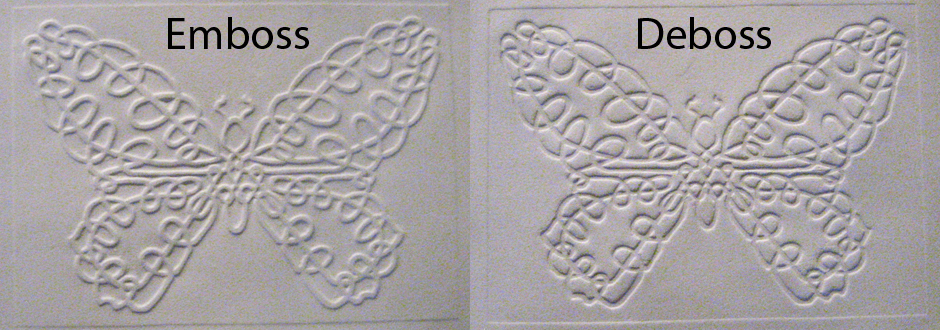
What is the different between embossing and debossing? They are basically the same thing, just stamped paper, but the difference is in the location from where it is stamped. Both are created using metal plates to essentially stamp the paper. Debossing means the paper is stamped on the front, making the image, text or graphic indent and make a depression down, or away from the front. Embossing is taking a metal plate and being stamped from the back back of the text, image or graphic. This raises or elevates the graphics.

Both embossing and debossing a great way to create a 3D effect and enhance certain texts or simple graphics that you want to highlight on your project. To further increase effect, many people add colored ink or foil stamping to certain words and images, as well as various depths of the embossing or debossing. This is a great way to make certain things stand out.

You usually see embossing and debossing on business cards, invitations (especially to weddings and other formal events) and sometimes on letterhead and greeting cards, among other marketing material. These help to add a feel and look of luxury and add a special touch to help you stand out, with very little expense.

Almost anything can be embossed or debossed, along with foil stamped. There are only a few restrictions such as paper type, certain graphics, and time allowed for completion.

Contact us today to learn more about embossing, debossing and foil stamping for your next project.

Example of Embossing

Embossed Bracelet

photo courtesy of wristbands.com.uk

Example of Debossing

Debossed Bracelet

photo courtesy of elito.com

Learn More

Reasons Why Your Direct Mail Campaign Did Not Work

Reasons Why Your Direct Mail Campaign Did Not Work

Have you heard that direct mail campaigns are the best return on investment than any other form of direct marketing? You tend to get more readers, more people responding to your call to actions, and the biggest bang for your buck. All that said, have you sent out some postcards or catalogs and not gotten the results you had hoped for? Check out our list below of some things that could be holding you back from some of those great results.

  1. Target Market:

Sending to the correct target market is the key to getting great results. You wouldn’t send a new child dentist announcement to a community of retiree’s, right? Make sure when creating or asking for a list, you have really homed in on the type of people and businesses you want to react to your mail piece. Looking for help on the best list? We can help!

  1. Compelling Offer:

Did you look over your list criteria meticulously and you still didn’t get the reaction you wanted? This could all come down to your offering or lack thereof. You need to make sure that your offer for people to act is compelling enough to actually make them act. Maybe you need to provide a steeper discount, offer a product for free, or give a longer or shorter timeline for someone to act.

  1. Poor Printing:

Although there are certainly ways to save on paper and other printing costs, make sure you are not going to cheapest route possible. Remember that you are representing your brand with your postcards, brochures, catalogs, and other direct mail pieces. The paper, patterns, colors and logos should be consistent across your brand and the image you are trying to portray.

  1. Setting Goals:

How can you track goals if you don’t have any set in the first place? Although it may sound obvious, be sure to have some sort of goal in mind before sending out that first direct mail piece. Don’t know where to start? We can help! Your goals should be tracked so you can see where you started, and where you ended up. Don’t have enough time to track? We can help with that too!

  1. Consistent Mailing:

Still waiting to see those results? Don’t worry! If you’ve only sent out one piece, you can’t expect success overnight! You need to make sure you are consistent with your mailing and getting the word out there. Be sure to make sure you stay on a schedule, and track the results accordingly. The more a company or individual sees your brand and offerings, the more likely they are to remember it and look you up when they are ready to buy!


Check out more of our tips and tricks on direct mail marketing and other business printing. Did you know we offer promotional products, apparel and vehicle wraps as well?

Direct Mail – The Best Way to Reach Customers

Direct Mail – The Best Way to Reach Customers

2020 has been one for the books, and it isn’t even over yet! Who would have thought that a couple weeks of quarantine, would turn into months of quarantine, work from home, and distance learning for our children? Summer came and went in a flash and much of our regular routines have been stripped away. With the ever-growing use of technology, from zoom to Netflix, digital ads are no longer getting the attention of your customers and clients. How to solve this? Direct Mail! Below are some great tips on how to use direct mail and its benefits


Target: digital marketing often does not go the desired targets, but rather a more general audience. Direct mail can get be nailed down to hit your target specifically to make sure you are getting more bang for your buck. Want to hit only a certain demographic within a certain neighborhood? We can help! Want to only send to certain age groups or employment types? We can help!

Track: did you know that we can monitor who receives direct mail and who is responding or using it? Depending on how your direct mail media is built, we can help track users and responders. This is a fantastic way to measure your return on investment!

Mix: It has been shown that adding direct mail into your marketing mix increases your chances of your target audience remembering your brand and taking action. Direct mail mixed with digital helps to increase brand awareness.


Looking to increase your marketing ROI and attract more customers? Direct mail is the way to go. Contract us today, we’d love to help!